
Sooner or later someone asks whether a company document is genuine: a bank onboarding the company, an auditor, a buyer's lawyer. Until now the only answer any corporate services firm could give was "send it to us and we will check", which means a person comparing a PDF with a PDF and everyone waiting for the reply.
That answer is now a link. Every document in our client portal carries a fingerprint that is anchored in the Bitcoin blockchain, and a Verify page that anyone can use, with no account and without contacting us. Here is what we built, what it proves, what it deliberately does not do, and why this is the one place in our practice where a blockchain earns its keep.
What happens to a document now
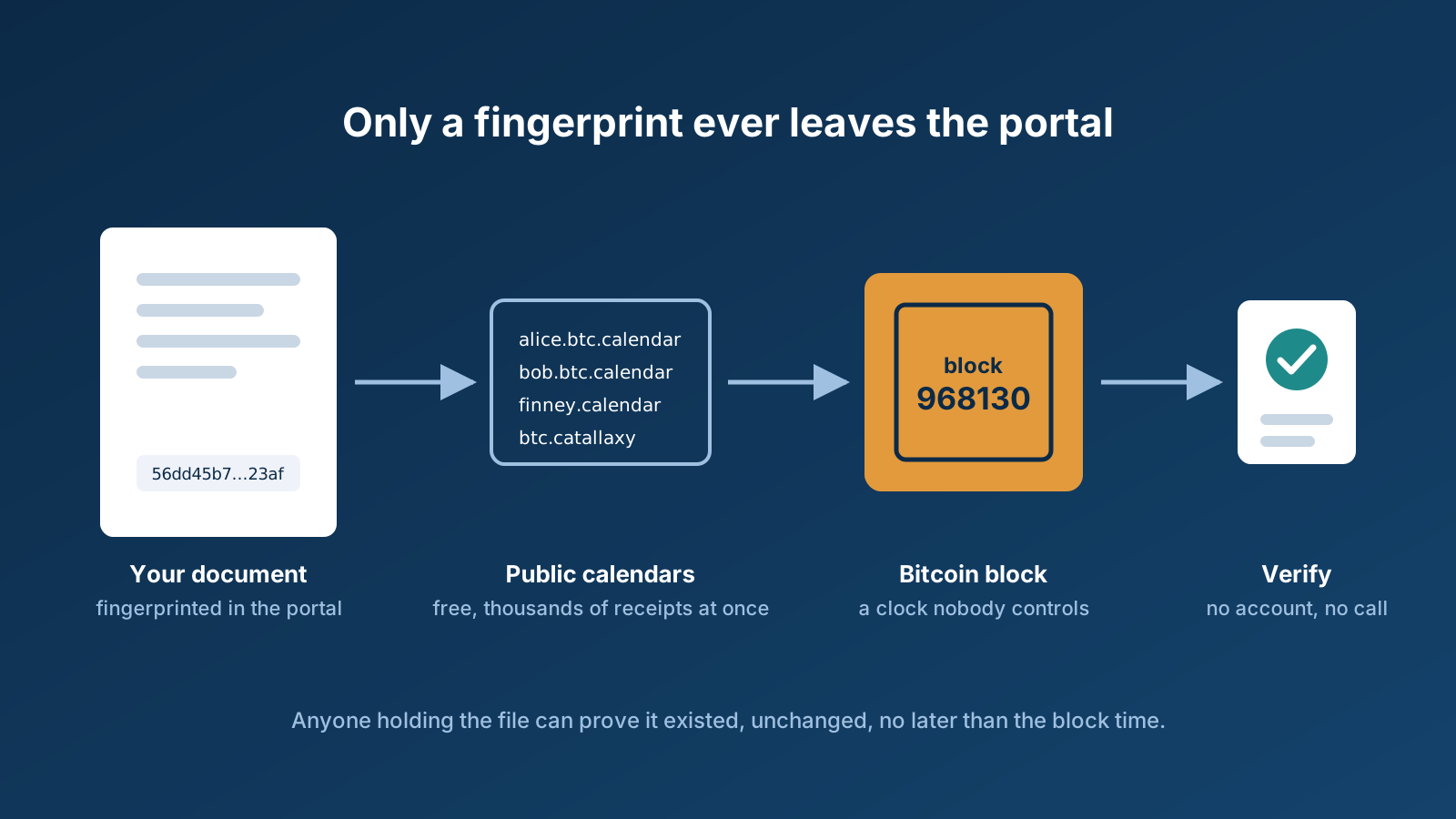
When a file lands in a client's portal, whether we filed it or the client uploaded it, a job computes its SHA-256 fingerprint, a 64-character code that changes completely if a single byte of the file changes. That fingerprint, mixed with a random value so it cannot be recognised, is submitted to the public OpenTimestamps calendars. The calendars gather thousands of such fingerprints from around the world, fold them into one Bitcoin transaction, and wait for it to be mined. A few hours later the portal collects the proof: the path from our fingerprint up to the block that contains it.
From then on the document shows a line in the portal: Anchored in Bitcoin block 968130 · Verify. The Verify page states when we recorded the file, which block anchors it, and the block's merkle root, checked live against a public block explorer so the visitor sees the comparison rather than taking our word for it. The proof file itself is downloadable and can be checked with the free OpenTimestamps client against the Bitcoin blockchain, without ever talking to us.
Documents we prepare ourselves, such as share certificates, board resolutions and confirmation sheets, also leave with a printed QR code. Paper cannot be fingerprinted, so that code carries the document's particulars signed with a key held only on our portal. Scanning it confirms that LAULEGA issued a document with exactly those particulars, and offers the file check for anyone who holds the digital copy.
What it proves, and what it does not
Precision matters here, because "recorded on the blockchain" gets used carelessly. The timestamp proves one thing, and proves it absolutely: the exact file existed, unchanged, no later than the moment that block was mined. Bitcoin blocks cannot be rewritten, and neither we nor anyone else can back-date one. A regulator asking whether client records were edited after the fact, or a court asking when a resolution was made, gets an answer that does not depend on trusting our database.
It does not, on its own, prove who created the file. That is why the printed code on our own documents exists, and why the Verify page says what was recorded and when rather than "this document is authentic". A scan of a signed paper is a different file from the original we filed, so the check applies to whichever file was actually recorded. And nothing about the client is revealed: the page shows a fingerprint, a date and a block, never a document name or a company. Whoever is checking already holds the document.
Why here, and nowhere else
I will be candid about the motive: I wanted something that sets our client portal apart from other providers, and "blockchain" is the word everyone reaches for. The honest question was whether it could do anything useful for a corporate services firm, and most of the obvious ideas do not survive inspection. Putting the register of members on a chain adds nothing: in Hong Kong the register kept by the company is the legal record, and a tokenised copy is a duplicate with no standing, holding personal data somewhere it can never be deleted. Decentralised identity for KYC is an extra step no bank accepts yet. Smart contracts for workflow replace software that can correct a mistake with software that cannot. Accepting crypto for fees raises source-of-funds questions on every payment for a licensed trust or company service provider.
Timestamping is the exception because it asks the blockchain to do the only thing it does better than anything else: provide a public clock that no party controls. The cost is zero, because OpenTimestamps is free public infrastructure and one Bitcoin transaction carries thousands of receipts. No tokens, no wallets, no gas. The only thing that ever leaves our systems is a salted hash. That is a differentiator a bank can actually use, which is the only kind worth having.
What this means for you
- Every document already in your portal is covered. The job worked through the whole library, oldest first, in its first day. Anything filed from now on is fingerprinted within the hour and anchored a few hours later.
- Sharing a document with a bank, auditor or lawyer is now the file plus its Verify link. They check it themselves in a minute.
- The receipts behind your books are covered too. For clients whose bookkeeping we keep, the supplier invoices and receipts that support the accounts are fingerprinted and anchored the same way. Those are the documents a tax audit asks about, and their age is now provable rather than asserted.
- Your compliance records have an independent clock. Under Hong Kong's anti-money-laundering rules, due diligence records must be kept for years; the question a reviewer asks is whether they were edited later. Now the answer is verifiable by anyone.
- Nothing changes in how you work. No setup, no wallet, no new login. The line simply appears under each document.
Documents your bank can verify without calling anyone
Every company we form or maintain gets the same portal: timestamped documents with a Verify link, a company secretary who keeps the statutory records in order, and audit-ready books through our accounting partner Certanta.
Hong Kong company servicesFrequently asked questions
What does the Bitcoin timestamp actually prove?
That the exact file existed, byte for byte, no later than the moment a particular Bitcoin block was mined. Nobody, including us, can move that date. It does not by itself say who created the file; for documents we prepare, the printed verification code covers that.
Is any of my company's information on the blockchain?
No. The only thing that leaves our systems is a fingerprint of the file, mixed with a random value before it is sent, so not even the timestamp servers see the real fingerprint. No names, no documents, no company details.
Does this cost anything or need a wallet?
No. It runs on OpenTimestamps, a free public service that folds thousands of fingerprints into one ordinary Bitcoin transaction. There are no tokens, wallets or fees, and nothing for you to set up.
How does a bank check a document I send them?
They open the Verify link next to the document in your portal, or scan the code printed on it, and drop the file in. Their browser fingerprints it locally, the file is never uploaded, and the page shows when we recorded it and which block it is anchored in. They can also download the proof and check it with the free OpenTimestamps tools without involving us.
The block number quoted is the one the first documents were anchored in on 22 September 2026. OpenTimestamps is an open-source project we do not control or pay for. General information, not professional advice for your specific situation.