
Last updated 5 September 2026.
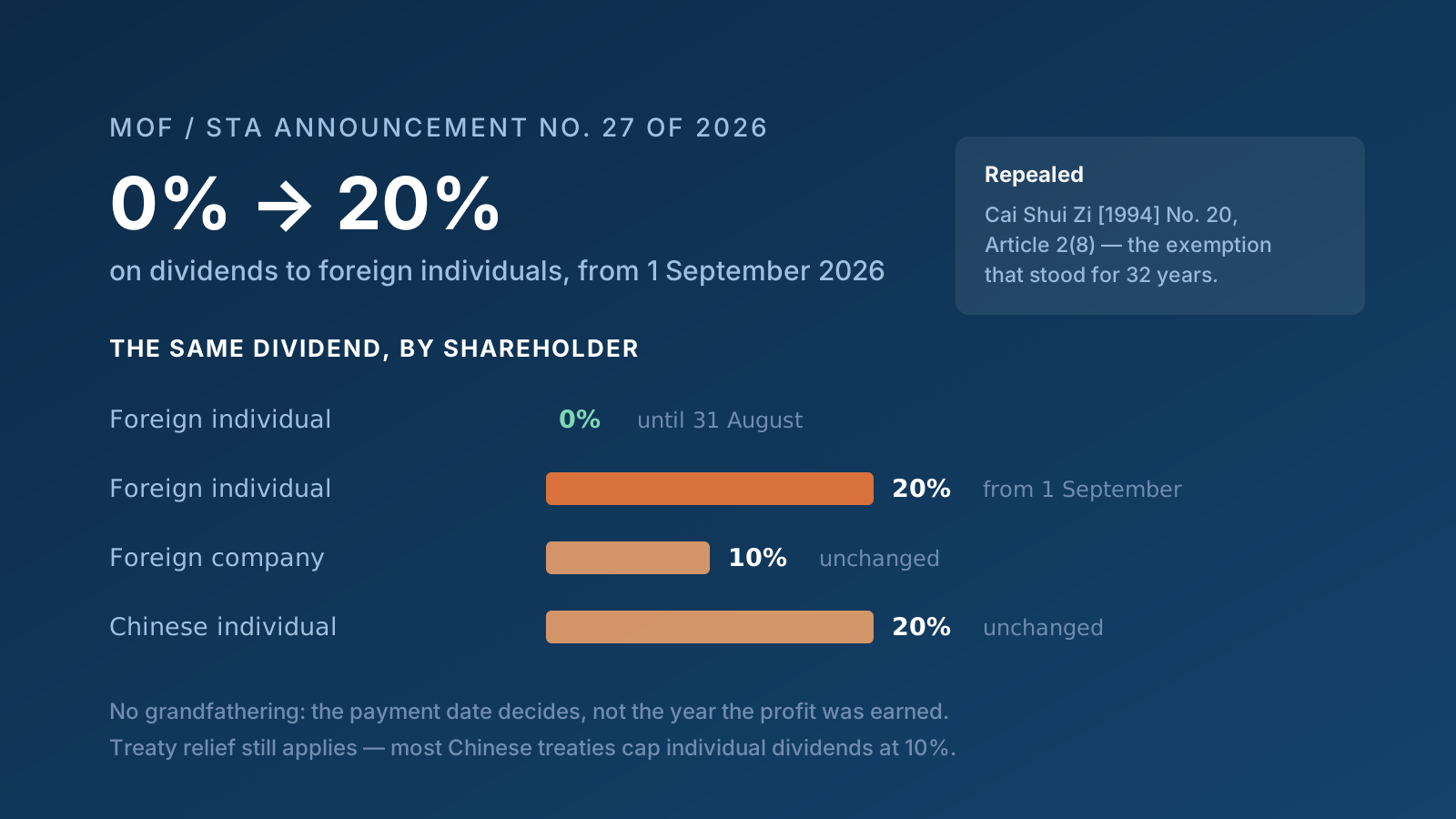
If you are a foreign individual holding equity in a Chinese company directly — a WFOE, a joint venture, any foreign-invested enterprise — the dividend you took last month was tax-free in China. The one you take next month is taxed at 20%.
On 1 September 2026 the Ministry of Finance and the State Taxation Administration published Announcement No. 27 of 2026, which does two things: it confirms that dividends and bonuses derived by foreign individuals from foreign-invested enterprises are taxed under the “interest, dividends and bonuses” category at the 20% rate, and it repeals Article 2(8) of Cai Shui Zi [1994] No. 20 — the provision that had exempted exactly that income since 1994.
Foreign corporate shareholders are untouched at 10%, and can reach 5% through a Hong Kong holding company. So the change does not just cost you 20% — it makes holding a WFOE in your own name the most expensive way there is to hold one.
What the announcement actually says
Three articles, and they are short.
The rate. Dividend and bonus income a foreign individual derives from a foreign-invested enterprise is subject to individual income tax as “income from interest, dividends and bonuses,” at 20%. The tax is on the gross distribution; there is no deduction and no allowance against it.
The mechanics. The FIE withholds when it pays and files within 15 days of the month following payment. Where the enterprise fails to withhold, the liability does not disappear — the foreign individual must pay the tax by 30 June of the following year, or by whatever deadline the tax authorities specify in a notice.
The date. Effective 1 September 2026, with Article 2(8) of the 1994 notice repealed on the same day.
What was repealed
Cai Shui Zi [1994] No. 20 was a housekeeping notice from the early reform era that swept together a set of concessions for foreign individuals. Article 2(8) exempted them from individual income tax on dividends and bonuses received from foreign-invested enterprises. It was drafted when tax exemption was one of the few levers China had to pull foreign capital in, and it survived the 2018 individual income tax overhaul that removed most of the rest of that generation of expatriate reliefs.
Note the scope of the repeal: only Article 2(8) went. The rest of the 1994 notice stands, and the announcement does not touch the separate exemption for foreign individuals on dividends from B shares and overseas-listed shares of Chinese companies.
The anomaly it closes
Until 31 August, the same profit distributed out of the same WFOE was taxed at three different rates depending on who held the shares:
| Shareholder | Withholding on dividends |
|---|---|
| Foreign individual | 0% |
| Foreign company | 10% (treaty rate may be lower) |
| Chinese individual | 20% |
The foreign individual was the only shareholder class paying nothing. From 1 September the individual column reads 20% — the same rate a Chinese individual pays on a dividend from a Chinese company. Foreign corporate shareholders are untouched at 10%, which produces a result worth sitting with: direct personal ownership of a Chinese company is now the most heavily taxed way to hold it.
Treaties still apply, and the gap is large
The announcement is silent on tax treaties, which means the ordinary rule holds: where a treaty or arrangement caps the source-country rate below 20%, a treaty-resident individual can claim the lower rate. Most of China’s treaties cap dividends at 10% for individual beneficial owners; the 5% band that appears in many of them, including the Mainland–Hong Kong arrangement, is generally reserved for corporate shareholders holding at least 25% of the capital.
For a foreign individual who qualifies, that is the difference between 20% and 10% — half the tax, on the same distribution. Claiming it is self-assessed rather than pre-approved: the non-resident taxpayer makes the determination, submits the treaty-benefit reporting form through the withholding agent so the reduced rate is applied at source, and retains the supporting documents — tax residency certificate first among them — for inspection. The retention period runs long after the payment, and beneficial-ownership scrutiny is real. A treaty claim that cannot be documented is worse than no claim.
Holding through Hong Kong is now clearly better than holding directly
This is the practical consequence, and it deserves more than a footnote. The announcement raised the rate on individuals and left corporate shareholders alone, so a gap that was already there has widened into the single largest variable in how a Chinese entity is held. Same company, same profit, same person ultimately receiving the money — and the tax differs by a factor of four depending on whose name is on the share register.
Take a distribution of RMB 1,000,000 out of a WFOE:
| How the WFOE is held | Chinese tax | Reaches the shareholder |
|---|---|---|
| Foreign individual, directly, no treaty claim | 200,000 | 800,000 |
| Foreign individual, directly, 10% treaty rate claimed | 100,000 | 900,000 |
| Hong Kong holding company, 10% | 100,000 | 900,000 |
| Hong Kong holding company, 5% (≥25% holding, beneficial owner test met) | 50,000 | 950,000 |
Hong Kong imposes no tax on the onward dividend from the holding company to the individual, so the Chinese withholding is the whole of the bill in the bottom two rows. That is what makes the 5% band worth structuring for: it is the only route to it. The 5% rate in the Mainland–Hong Kong arrangement, like the equivalent band in most of China’s treaties, is reserved for corporate shareholders holding at least 25% of the capital — an individual holding directly cannot reach it however long they have held the shares. The best a direct individual holder can do is 10%, and only with a documented treaty claim; without one they are at 20%.
Read the table the other way and the point is sharper still. Direct personal ownership is now the most heavily taxed way to hold a Chinese company — worse than a foreign corporate shareholder, and worse than a Chinese individual has ever had it, since the Chinese individual at least holds the domestic company directly and pays the same 20%. For anyone setting up a WFOE from here, the holding company is no longer the institutional option; it is the default, and direct ownership is the choice that needs justifying.
What the structure has to be able to survive
Two cautions, and neither is optional.
First, the beneficial owner test is not a formality. A Hong Kong company with no substance, no employees and no function beyond holding the shares invites a denial of the reduced rate under the Mainland’s beneficial-owner rules, and the general anti-avoidance provisions sit behind that. A holding company that exists only in a filing cabinet buys you the 20% you were trying to avoid, plus an argument. The 5% band in particular is examined, because it is worth examining.
Second, restructuring after the profits already exist is not a clean fix. Transferring equity in a Chinese company triggers its own tax event on the transfer itself, and inserting a holding company between yourself and a decade of accumulated retained earnings shortly before distributing them is precisely the fact pattern anti-avoidance rules were written for. The structure is cheap to get right at incorporation and expensive to retrofit on the eve of a distribution — which is the argument for deciding it now rather than when the money is already sitting there.
And one thing the holding company does not do: it does not settle what you owe where you live. Hong Kong not taxing the onward dividend is not the same as nobody taxing it. Your own country of tax residence applies its own rules to the dividend it receives, and the Chinese tax paid is generally creditable against that. The structure decides the Chinese bill; it does not decide the whole bill.
Timing: there is no grandfathering
The announcement keys to payment, not to the year in which the profit was earned. A dividend paid on or after 1 September 2026 out of retained earnings accumulated over the previous decade is taxed at 20%. Distributions made before 1 September follow the old rules.
If your company resolved on a distribution in August but has not paid it, the payment date is what the withholding agent will be looking at.
The compliance point most owners will miss
The withholding obligation sits with the FIE, and the filing deadline is tight — within 15 days of the month following payment. But the announcement expressly assigns the fallback liability to the individual: if the company does not withhold, you pay, by 30 June of the following year. Small foreign-invested companies whose finance function is a part-time bookkeeper are precisely the ones likely to miss a first-time withholding obligation, and the shareholder inherits the exposure, plus the late-payment surcharge that runs daily.
If you own a Chinese entity and expect to distribute anything in the next year, the two questions to answer before the payment date are whether the payer’s books are set up to withhold and file on time, and whether you qualify for a treaty rate and can evidence it.
Holding a WFOE in your own name?
We set up and administer Chinese foreign-invested enterprises and the Hong Kong holding companies above them, and we can tell you what a distribution costs you under each shape before you commit to one. Tell us how the entity is held today and what you expect to distribute.
Talk to usFrequently asked questions
Should I hold my WFOE through a Hong Kong company instead of personally?
From 1 September a direct individual holder pays 20%, or 10% with a documented treaty claim. A Hong Kong holding company pays 10%, or 5% where it holds at least 25% and meets the beneficial owner test, and Hong Kong does not tax the onward dividend. The 5% band is closed to individuals holding directly. It needs real substance, and retrofitting it over existing retained earnings triggers its own tax event.
Does this apply to dividends from Chinese companies that are not foreign-invested enterprises?
The announcement addresses dividends from foreign-invested enterprises specifically, because that is what the 1994 exemption covered. Dividends from other Chinese companies were already taxable to foreign individuals at 20%.
Does it apply to Hong Kong, Macau and Taiwan individuals?
The text says “foreign individuals.” Hong Kong, Macau and Taiwan residents have historically been treated by analogy to foreign individuals under this generation of rules, but that treatment rests on separate instruments — confirm your status before relying on either outcome.
Can I still get 10% instead of 20%?
Where you are a tax resident of a jurisdiction whose Chinese treaty caps dividend withholding at 10%, and you are the beneficial owner, yes — through a treaty claim filed with the withholding agent and supported by a residency certificate.
What about profits earned before 2026 that I have not yet distributed?
Taxed at the rate applying on the payment date. The year the profit was earned is irrelevant.
Is the 20% creditable in my home country?
Generally yes, subject to your own country’s foreign tax credit rules, which this announcement does not affect.
Does this change anything for foreign corporate shareholders?
No. The 10% enterprise income tax withholding on dividends to non-resident companies, and any lower treaty rate, are unchanged.
This article is general information about a published tax rule, not tax advice on your circumstances. Cross-border dividend planning turns on residency, holding structure, substance and treaty eligibility — all of which are facts specific to you.
Sources: MOF/STA Announcement No. 27 of 2026 (1 September 2026); Cai Shui Zi [1994] No. 20.